
In March 2009 I asked the butchers at the Ginger Pig about the copper-colored Tamworth that gave the shop its name. They could take me all the way back to the barley, oats and wheat grown for the pigs on their farms in the North York Moors. Longhorn cattle and Dorset sheep grazed there too. A whole side hung in the shop to tenderize, and the butcher could show me where my cut for supper came from.
Traceability means being able to follow that journey. A butcher who knows the farm can talk about feed, pasture, slaughter and hanging, then suggest how to cook a cut you have overlooked. I made a habit of buying meat less often and spending more care on each purchase. That left the people doing the raising, cutting and selling in the conversation as well.
London, Vienna and a Tuscan butcher
At Daylesford in London, a mushroom quiche warmed by the oven and a glass of sparkling elderflower from Devon made an excellent lunch during a week of food-policy reading. The butchers spoke about animals raised on their farm in the Cotswolds and slaughtered at its own abattoir. The wheat went to the mill for the shop’s bread. The little speckled eggs came from the quails. Tarte Tatin finished the meal. On another evening there had been truffle risotto and bread pudding.
Vienna’s Naschmarkt made me wish I could take a kitchen on holiday. A sausage and a forkful of the fresh, slightly sweet sauerkraut made a good lunch on foot. Down in a cellar we ate roast pork and beef, blood sausage and great stuffed dumplings on a bed of cabbage. Our last meal in Vienna was schnitzel. The crisp breading overlapped the plate, and half a lemon was all it needed.
We reached San Gimignano between lunch and dinner. There was a bowl of sausages and Tuscan beans to be had, and a window full of cinghiale prosciutto, cured wild boar. Much as I admired all that ham, I still had room for the region’s ricciarelli. The little almond diamonds dry until a skin forms, then get a dusting of powdered sugar before they go into the oven.
A Burns supper at Mudchute
In January 2010 we had a Scottish supper on the Isle of Dogs. Robert Burns wrote an address to a haggis, which strikes me as a very good reason to give offal and oatmeal pride of place at dinner. Here’s what came out of the farm kitchen that night.
On Skye the cream came with oats and raspberries instead.
Chicken stock that sets when cold
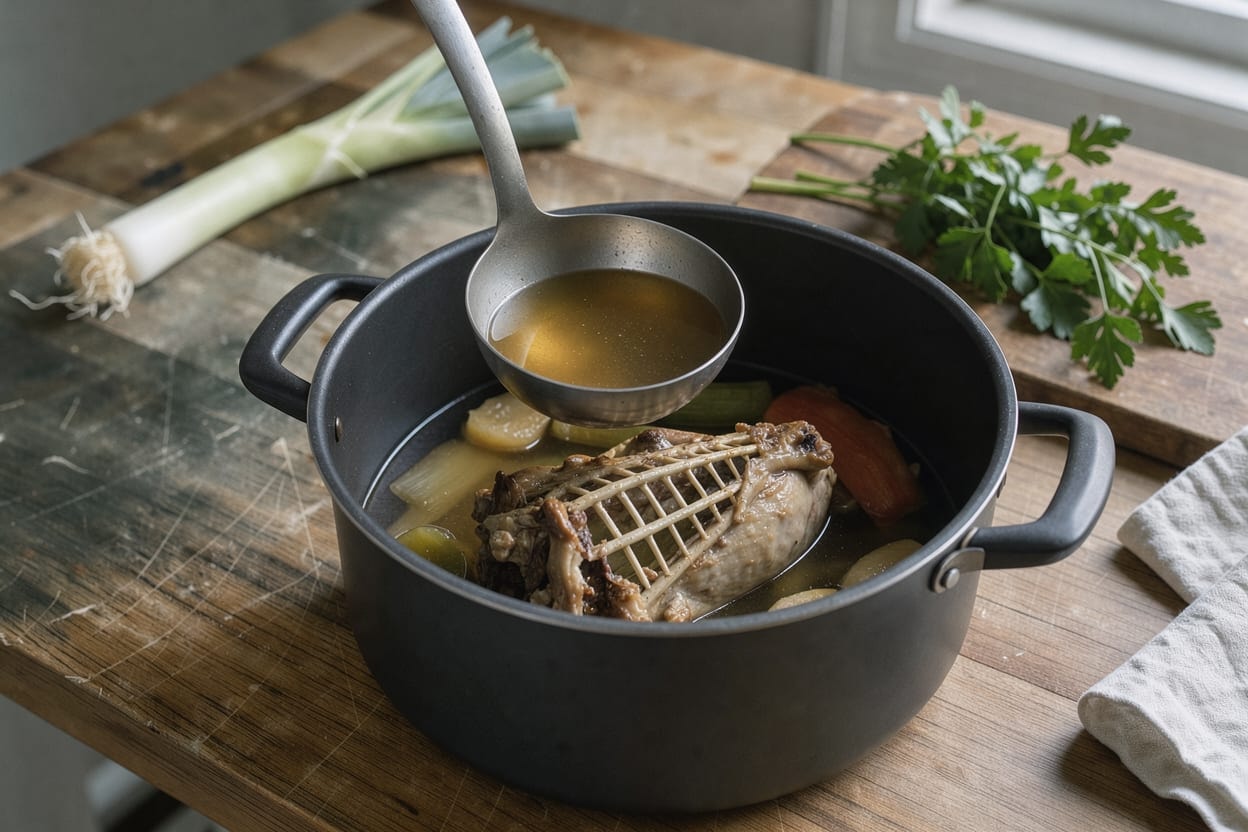
The frame left from a roast makes a base for soup and a gravy for pot pie. Put the frame, wing tips and a few trimmings of onion, carrot or leek into a pot. Cover with cold water, bring slowly to a simmer and skim the surface. Keep the liquid barely moving. After a few hours taste a spoonful. When it tastes of chicken, strain and divide into shallow containers to cool promptly. Refrigerate within two hours, or one hour if the air temperature is above 90°F / 32°C. Use cooked leftovers within three to four days or freeze. FoodSafety.gov on cooling and reheating · Cold storage times
In the refrigerator a good stock may set into a soft gel. Skin, tendons and other connective tissues contain collagen, a structural protein. During moist cooking, some collagen becomes soluble gelatin. As the stock cools, gelatin can hold water in a loose network. Warm it and the stock flows again. How firmly it sets depends on the parts, the amount of water and how far the pot has reduced. Liu and colleagues on collagen and gelatin
Roast chicken under pastry
There is no need to weigh last night’s roast to make a pot pie. Set out the baking dish and judge the filling by what fits under a lid of puff pastry. Shred the cooked chicken. Wash and cook the vegetables first. The London version had plenty of leeks along with corn, celery and green beans. Turkey, sprouts and a little mashed sweet potato work after Thanksgiving. Save the roasting juices.
Cook butter and flour together to make a roux. Whisk in the drippings and chicken stock until the gravy coats a spoon, then finish with a little cream. Toss with the meat, vegetables, parsley, salt and pepper. Fill the dish. Cover with thinly rolled puff pastry, slit the top for steam and brush with beaten egg. Bake at 350°F / 175°C until the pastry is puffed and golden and the center of the filling reaches 165°F / 74°C.
Recipe
Winter slaw
To serve alongside the pot pie
Ingredients
- 1 cupshredded beets
- 1½ cupsshredded carrots
- 1 cupshredded cabbage
- ½ cupthinly sliced celery
- 1 small handfulroughly chopped parsley
- ½ cuppomegranate seeds
- ¼ cupfreshly squeezed orange juice
- 2 tbspolive oil
- To tastesalt
- ½ cuptoasted, roughly chopped walnuts
Method
- Toss the beets, carrots, cabbage, celery, parsley and pomegranate together. Dress with orange juice, olive oil and salt. You can do this part ahead.
- Fold in the walnuts just before serving so they keep their crunch. For the English winter version, use pressed apple juice, rapeseed oil and toasted pumpkin seeds. Leave out the pomegranate.
From connective tissue to a research question
Collagen helps give structure to tissues such as skin, tendon and cartilage. Protein is made of chains of amino acids. Digestion breaks proteins down into smaller pieces, including short chains called peptides and individual amino acids. Researchers can measure some of these pieces after a meal. A study of cooked fish, for example, looked for particular collagen-derived peptides in blood after participants ate it. The measurement answers a question about digestion and absorption. MedlinePlus on dietary protein · Asai and colleagues on cooked fish
One study analyzed amino acids in different broths and found substantial variation among preparations. Separately, researchers have studied defined collagen preparations and joint-related measures in people. A 2025 review reported differences in study populations, lengths and outcome measures that limit how widely the findings can be applied. A homemade pot pie was outside those studies. A clinician can discuss joint symptoms or questions about your own health. Alcock and colleagues on broth composition · Brueckheimer and colleagues’ review